
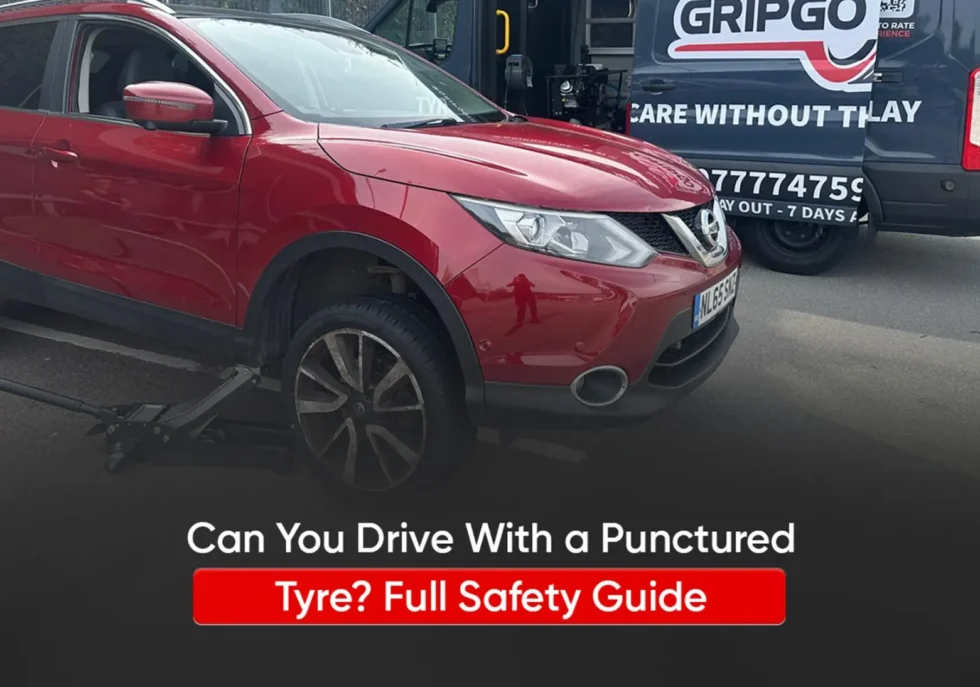
It’s 7:45am on the North Circular and the steering wheel just started pulling left. Or maybe it’s the school run down a Sutton side street, and the dashboard’s flashed up an amber tyre warning light you’ve never seen before. In both cases, the question is the same: can you drive with a punctured tyre, or do you need to stop right now?
The short answer is no not for any real distance, and not without understanding what you’re risking. But “no” on its own isn’t much use to a driver stuck on a slip road with somewhere to be. So let’s go through exactly why it matters, what causes punctures on London’s roads specifically, and what to actually do when it happens to you.
The Quick Answer
If a tyre is visibly flat, sagging at the sidewall, or losing air fast, you shouldn’t drive on it not even to the end of the road if you can help it. Can you drive with a punctured tyre for a very short, careful distance to reach a safe stopping point (off a live lane, out of a cycle lane, away from a blind bend)? Yes, that’s acceptable. Driving it several miles to a garage because it’s “not that flat yet” is where things go wrong.
The Highway Code is unambiguous on this: tyres must be correctly inflated and free from cuts or defects at all times. A punctured tyre that’s losing pressure fails that test, which means the vehicle is technically no longer roadworthy the moment the puncture happens.
Why This Actually Matters (Beyond the Obvious)
There are three separate risks stacked on top of each other here, and most drivers only think about the first one. The real question of can you drive with a punctured tyre isn’t just “will I get there” it’s safety, cost and legality all at once, and understanding all three is what changes how you react next time it happens.
Safety
A tyre running low on pressure or fully flat loses its ability to grip, corner and brake predictably. Can you drive with a punctured tyre and get away with it once or twice? Possibly. But the moment you hit a pothole, a wet roundabout, or need to brake hard for a cyclist, a compromised tyre behaves unpredictably and London traffic doesn’t give you much room for that.
Cost
This is the one drivers underestimate. A repairable puncture caught early might cost you £20–£40. Keep driving on it and the sidewall folds under the vehicle’s weight, the wheel rim can start grinding against the road surface, and you’re suddenly looking at a full tyre replacement and sometimes a damaged alloy wheel too. If you’ve ever wondered why a simple nail turned into a £150 bill, this is usually how.
Legal exposure
Driving on a defective tyre is an offence under Section 41A of the Road Traffic Act 1988. Get pulled over on a flat and you can be looking at a fixed penalty and points on your licence, on top of whatever repair bill is already coming. The full legal wording sits in the Highway Code, which is worth a read if you want the exact rules rather than someone’s paraphrase of them.
What Actually Causes Punctures on London Roads
Anyone who’s spent time driving in the capital knows tyre damage here has its own flavour. It’s rarely a mystery nail lying in an empty field it’s usually one of these, and the cause is often the deciding factor in can you drive with a punctured tyre safely or not:
Potholes and patched-up resurfacing
Particularly on borough roads that don’t get the same attention as TfL red routes
Roadworks debris
Screws, bolts and metal shavings left behind near construction sites, which are everywhere at the moment
Kerbing
Tight parking on narrow residential streets damages sidewalls in a way that doesn’t show up as a puncture straight away, sometimes appearing as cracks in tyres weeks later
Congestion zone stop-start driving
Constant heavy braking and slow manoeuvring puts more stress on tyres already carrying under-inflated pressure than most drivers realize
Glass and general road debris
a byproduct of dense urban traffic that motorway drivers see far less of
Regularly checking your tyre tread depth and pressure makes you far more likely to catch a slow puncture before it becomes a flat one, especially if you’re covering short, stop-start city journeys where a slow leak is easy to miss.
Slow Puncture vs Blowout: They’re Not the Same Problem
Not every puncture behaves the same way, and that changes what you should do because can you drive with a punctured tyre has a different answer depending on which of these two you’re dealing with.
A slow puncture a nail or screw partially embedded, or a valve slowly losing air and gives you some warning. Your car might pull gently to one side, or a tyre pressure warning light might come on before things get serious. This is the scenario where driving a short, careful distance to a safe location is genuinely reasonable.
A blowout is sudden and gives you no warning at all a bang, a lurch, and the vehicle pulling hard toward the damaged side. Here there’s no debate: pull over as soon as it’s safe, don’t brake sharply, and don’t attempt to keep driving under any circumstances.
If your car has a tyre pressure monitoring system, it should flag a drop before you feel anything through the wheel and one of the more useful bits of modern car tech for exactly this reason.
What To Do When It Happens
If you’re still weighing up can you drive with a punctured tyre right now, this is the order to work through:
- Get somewhere safe first. A lay-by, side street, petrol station forecourt anywhere off a live lane or blind corner. Hazards on.
- Assess before you decide anything. Is it a slow leak or fully flat? Is the object still lodged in the tread (leave it there and removing it can make things worse) or is there visible sidewall damage?
- Use what you’ve got. A tyre inflation kit or sealant can buy you 50–100 miles at reduced speed if the damage is minor and central. It’s a stopgap, not a fix the tyre still needs professional inspection afterwards.
- Know your limits. If you’re not confident changing a tyre yourself, or the puncture happened somewhere genuinely dangerous, a motorway hard shoulder, a blind bend, call for help rather than attempting it solo.
- Get it looked at the same day. Even a “successful” temporary fix isn’t a long-term answer a proper tyre puncture repair will confirm whether it’s fixable or whether you’re looking at a replacement, and if you’d rather not drive anywhere at all, a mobile tyre repair can come to wherever you’ve stopped.
Comparing Your Options
Every answer to can you drive with a punctured tyre depends on which of these you actually have available to you:
| Option | Distance you can cover | Best for |
|---|---|---|
| Drive very short distance to safety | A few hundred metres, low speed | Reaching a lay-by or side street off a live lane |
| Sealant/inflation kit | Up to ~50–100 miles, reduced speed | Minor, central punctures with no sidewall damage |
| Spare wheel | Until you reach a garage | Cars still fitted with a full-size or space-saver spare |
| Run-flat tyre | Manufacturer-stated range, usually 50 miles at reduced speed | Cars specced with run-flats from the factory |
| Call for mobile assistance | N/A — help comes to you | Motorway, blind bends, or if you’re simply not confident doing it yourself |
Prevention Beats Cure
Most punctures that turn into expensive repairs share one thing in common: nobody was checking the tyre regularly enough to catch the early warning signs. The best answer to can you drive with a punctured tyre is not needing to ask the question in the first place. A few habits make a real difference:
- Run a proper tyre pressure check monthly, including the spare annd most drivers only think about it after a warning light appears
- Glance at tread depth during routine checks; UK law requires a minimum of 1.6mm across the central three-quarters of the tread, and TyreSafe recommends checking well before you get anywhere near that limit
- Look for cuts, bulges or embedded debris after driving through roadworks or over potholes
- Get your wheels aligned if the car pulls to one side even slightly and uneven wear from poor alignment makes tyres more puncture-prone over time
Two London Stories That Sum This Up
A regular cabbie working the routes near the North Circular once described picking up a slow puncture from a pothole he’d driven past a hundred times without issue the one hundred and first time, a chunk of loose tarmac did the damage. He didn’t notice for two days because the leak was gradual, and by the time he checked pressure at a routine stop, the tyre had already picked up enough internal damage that it needed replacing rather than repairing.
A parent doing the Sutton school run had the opposite experience a screw sat in the tread for over a week without causing any noticeable problem, because it hadn’t fully pierced the inner lining. A routine pressure check caught it before it became a roadside emergency. Same object, same postcode, completely different outcome because one driver was checking regularly and the other wasn’t. Both stories answer can you drive with a punctured tyre the same way: technically for a while, but not without consequences catching up eventually.
FAQs
How can I tell the difference between a slow puncture and a sudden flat?
A slow puncture usually shows up gradually, a pressure warning light, slightly heavier steering, or extra road noise over a few days. A sudden flat is unmistakable: a loud bang, immediate vibration, and the car pulling hard to one side. Both need attention straight away, but a slow puncture gives you more warning to act before it becomes an emergency.
Can I drive on run-flat tyres after a puncture?
Yes, but only within the limits set by the manufacturer. Run-flat tyres have reinforced sidewalls that let you keep moving, typically up to around 50 miles at a reduced speed, purely to reach a garage rather than wait roadside. Pushing beyond that distance or speed risks the same damage as driving on a standard punctured tyre.
What should I do if a screw or nail is stuck in my tyre?
Leave it where it is rather than pulling it out yourself. The object may actually be slowing the air loss, and removing it can make the puncture worse. Drive as little as possible and get the tyre to a fitter as soon as you safely can.
Is it illegal to keep driving on a tyre I know is punctured?
Yes, it can be. Under the Highway Code, vehicles must stay roadworthy at all times, and driving on a tyre that's damaged or below the legal 1.6mm tread depth can result in fines and penalty points if you're stopped, on top of the safety risk.
So, Can You Drive With a Punctured Tyre?
Not safely, and not for any real distance. Can you drive with a punctured tyre to reach the nearest safe stopping point? Yes, carefully. Beyond that, you’re trading a small repair bill for a much bigger one or worse, a genuinely dangerous situation on a road that doesn’t forgive mistakes.
If you’re the type who’d rather catch problems early than deal with them at the roadside, we’ve put together a free seasonal tyre safety checklist covering exactly what to check and when no calls, no sales pitch, just the same routine our own team follows. Grab it below and you’ll never be caught out wondering what that dashboard light actually means.
